

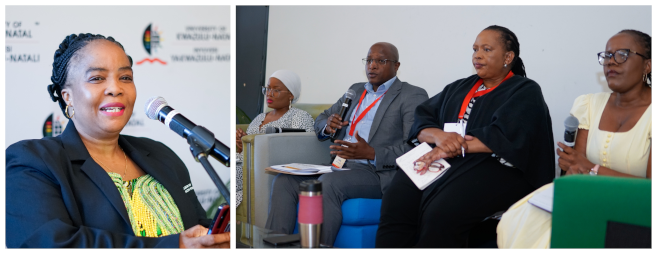
UKZN in partnership with various stakeholders hosted the Early and Unintended Pregnancies (EUP) in Eastern and Southern Africa Conference at the UNITE building on the Howard College campus.
EUP, a global public health concern particularly affecting developing countries, relates to unplanned or unexpected pregnancies that occur at a young age. It is often associated with increased risk of adverse health and social consequences for the mother and her newborn with Eastern and Southern Africa having some of the highest rates of adolescent pregnancies worldwide – twice the global average at 92 births per 1 000 girls!
Other hosts of the conference included the South African National AIDS Council (SANAC), the United Nations Population Fund (UNFPA), the Department of Social Development (DSD), the KZN Office of the Premier, the Human Sciences Research Council (HSRC), the President’s Emergency Plan for AIDS Relief (PEPFAR) partners (TBHIVCare, MatCH, NACOSA, WitsRHI) , the United States Agency for International Development (USAID), and the Centre for Disease Control (CDC) with support from UKZN’s Corporate Relations Division (CRD).
The conference aimed to foster meaningful dialogue and critical reflection on EUP and give participants the opportunity to explore pivotal questions around effectively reducing the incidence of EUP while enhancing the quality of life and securing a brighter future for both female and male adolescents.
The conference was contextualised within the triple and interrelated threats of early and unintended pregnancies, sexual and gender-based violence (GBV), and HIV and AIDS. Government, civil society, academia and the private sector were well represented during the two-day comprehensive conference.
Deputy Vice-Chancellor and Head of UKZN’s College of Health Sciences Professor Busisiwe Ncama set the tone for the conference saying in her welcome address that ‘this platform has brought us together to help bring dignity to people’s lives by identifying community centred partnerships and solutions to these worrying issues. We must rise to this multi-faceted challenge to ensure our youth reach and fulfil their true potential.’
Delegates from partner organisations delivered messages of support which highlighted the urgent need for action and collaboration to make real strides in tackling the issues.
Other than the far-reaching health risks faced by young mothers, speakers highlighted the importance of strengthening awareness programmes inside and outside schools, better access to reproductive and sexual health services for the youth and developing initiatives which address gender inequality and GBV.
KZN Provincial Civil Society representative Mr Patrick Mdletshe raised the important issue of the impact of technology and social media on the youth calling for more effective regulation in this area. ‘These platforms widen the generational gap and can be used to encourage early sexual debut and pregnancy therefore they need to be monitored or regulated,’ he said.
Professor Kay Govender of the Health Economics and HIV and AIDS Research Division (HEARD) encouraged delegates to use the conference as a call to action for collaboration to develop youth-friendly health services. Said Govender: ‘We need to create networks of advocates who are dedicated to empowering young people to take control of their lives in meaningful ways. We must become the champions of non-judgemental healthcare services for our youth.’
This key message was underscored several times during the conference by speakers and panellists.
Lively plenary sessions over the two days focused on a cross section of issues such as perspectives of youth frontline workers in EUP, policy and law enforcement’s roles in addressing EUP, the role of health systems in addressing and responding to EUP, and the community intervention religious and traditional leaders’ role in preventing EUP.
The keynote address was delivered by Mr Yu Yu of the United Nations Population Fund (UNFPA). As Country Director for Eswatini and Botswana and representative for South Africa, his sobering message reminded participants that EUPs are a manifestation of the deep rooted social and economic conditions faced today as a society. ‘There are many challenges, however, if we use a development mindset we can effect change on an individual and community level,’ he said. ‘The research proves that South Africa has the knowledge, skill and resources to tackle this issue, however, implementation, accountability and monitoring of effective programmes and policies are vital.’
Yu stressed the importance of collaboration and issued a challenge to all stakeholders to work more effectively together to explore innovative cross-sectoral approaches, strategies, and actions to mitigate EUP, particularly their intersection with Sustainable Development Goals (SDGs) on education, environment, climate change, livelihoods, gender, and adolescent health issues.
In closing, the rapporteur for the conference and academic leader of Community Engagement in the School of Built Environment and Development Studies (SoBEDS), Professor Yanga Zembe, summarised the main areas of further collaboration to animate the recommendations. Additionally, the conference organiser and convener, Professor Ernest Khalema, the former Dean and Head of the SoBEDS and current Deputy Vice Chancellor of the College of Law and Management Studies, noted ‘the objective of the conference was to question the existing gaps in the evidence regarding the drivers of reducing EUP in the region and investigate how we can improve policy dialogue to ensure a comprehensive and inclusive approach.
‘After these two days I have realised that there are many exciting opportunities to enhance collaboration and strengthen synergies among our different sectors in promoting effective practices for reducing rates of EUP,’ he said.
Words: Jennene Naidu
Photographs: Yola Ndzabe